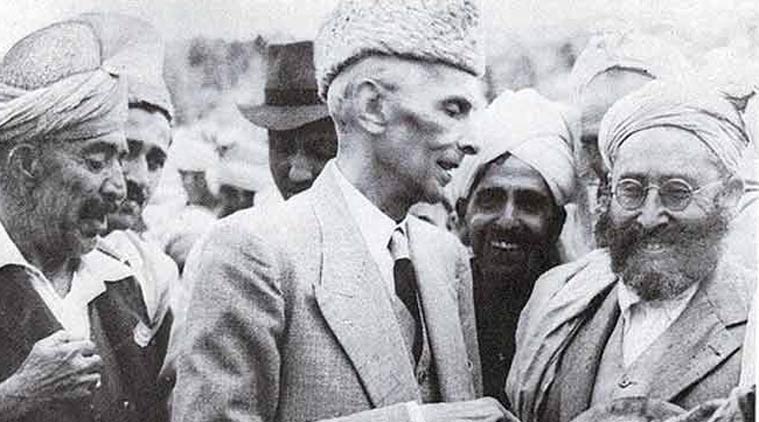
A BJP MP wrote to Aligarh Muslim
University last month, demanding to know why a portrait of Pakistan’s founder
Muhammad Ali Jinnah was hanging on the wall of the students’ union office. AMU
explained that Jinnah was a founder member of the university court who had been
given life membership of the union 80 years ago, and that his portrait had been
there for decades. However, protests and clashes on campus followed.
SALIL MISRA, historian of Modern
India and Pro-Vice Chancellor of Ambedkar University Delhi, explains to The
Indian Express the historical context of Jinnah’s politics, and why it
continues to retain relevance for certain groups in India.
Why does Jinnah provoke anger
even 70 years after Independence?
The mainstream Indian nationalism that started developing from the end of
the 19th century was civic and territorial. It was based on the idea that all
Indians, irrespective of their language, religion and culture, were part of the
single Indian nation. This idea of Indian nationalism was, of course, very
uneven in its spread. It did not reach all groups, communities and regions at
the same time. But it did become the template for mainstream Indian
nationalism, and was espoused by Naoroji, Gandhi, Tagore and Jawaharlal Nehru,
among others. Jinnah’s major
intervention in Indian politics from the 1940s onward represented an emphatic
and categorical denial of this idea of the single Indian nation. He led a
massive political movement around the idea that the Indian people were not one,
but two nations — Hindu and Muslim — that could not live together. In a climate
in which territorial Indian nationalism had become the most popular way to
imagine the Indian nation, the politics and ideology of Jinnah, particularly
after 1940, provoked offence and animosity.
Indian society lives in the
shadow of Partition even today. The search for the “real culprits” behind the
division of India continues. And prima facie, Jinnah seems to fit the bill. The
decades since the 1980s have seen a particularly aggressive form of Hindu
communalism masquerading as “nationalism”, which has debunked the inclusive and
plural idea of Indian nationalism as “pseudo secularism”. This brand of
majoritarian politics has created its own heroes and villains for the
“historical wrongs” done to Indian society. In this version of history, Jinnah
emerges as the main villain, for reasons that are obvious.
But was Jinnah the
unquestioned leader of Indian Muslims?
Certainly not, until at least
1937. He was only one of several, and a large number of important Muslim
leaders were with the Congress. There were hardly any takers for Jinnah among
the Muslims of Punjab, Bengal and Sind. However, after taking over the
leadership of the Muslim League in 1937, Jinnah launched a powerful political
campaign to dub the Congress as a purely Hindu body, and to preach political
separation between Hindus and Muslims. He projected a Congress-Muslim divide as
a Hindu-Muslim divide, and argued that a Congress government would be a “Hindu
Raj”, and that Muslims would be persecuted in Hindu-dominated independent
India. He also began argued that India was basically unsuited to modern
democracy. His tireless campaign proved to be successful, and it can be said
that by 1940, Jinnah was indeed the most influential political leader among
Indian Muslims.
So what is it that led him to
abandon the Congress idea of Hindu-Muslim unity and demand a separate Muslim
nation?
Jinnah began his political career
in the Congress, and was a votary of united territorial Indian nationalism. He disapproved when the Muslim League was
formed in 1906, frowning at its pro-British and elitist orientation. It was
only in 1913 that he joined the League, when its politics began to turn against
the British. It is possible that he was persuaded by Congress colleagues in
order to bring the League closer to the Congress. Jinnah was instrumental in
effecting a pact between the Congress
and the League in 1916.
Jinnah, at this time, was a believer in the old moderate type of
politics. He left the Congress in 1920 after it began, under Gandhi’s
influence, to change into a mass organisation with a radical programme that
included non-cooperation and civil disobedience against the British. He
began to work on organising a separate political platform of Indian Muslims
which, in the 1930s, developed in an exclusively separatist and communal
direction. By the end of the decade, this platform had adopted an extreme
communalist position and begun to demand complete political separation between
Hindus and Muslims.
Was Jinnah the first to
propound the two-nation theory?
Some vague ideas of political
separation had begun to develop since the late 19th century. In the early 20th
century, with the growth of active Hindu and Muslims communalisms, these ideas
began to gather momentum. In 1930, Sir
Muhammad Iqbal said at the Muslim League session in Allahabad that all Muslims
of North-West India could be organised into a separate polity. In 1937, V D
Savarkar declared from the platform of the Hindu Mahasabha that Hindus
constituted a nation in themselves. This was nothing but a variant of the
two-nation theory.
The two-nation theory should be
understood as the product of the steady communalisation of Indian politics and
society since the late 19th century. The British played a particularly negative
role in this process, by creating institutional structures that kept the two
religious communities separate from each other. They did this through a model
of democratic politics in which voters, constituencies and candidates were all
divided along religious lines. Hindus and Muslims were grouped as separate voters
and constituencies. This provided great incentive to organisations claiming to
champion separate Muslim and Hindu interests.
In recent times, Jinnah has
been reassessed as a constitutionalist by, among others, L K Advani and Jaswant Singh,
essentially on the basis of his first speech to the Pakistan Constitutent
Assembly. How valid is this reassessment?
One should not read too much into
a single statement made by Jinnah after Pakistan had been granted by the
British. To assign prime causative value to a single isolated statement, to the
exclusion of the wider context, does not make for a valid historical
explanation. From 1940 onward, Jinnah
had launched a powerful communal movement among Indian Muslims, and it was
obviously not possible for him to retreat from that. The extreme communalism he
had unleashed was the genie trapped in the bottle of history. His address to
the Constituent Assembly reflects at best a feeble desire to put the genie back
after it had served its purpose.
Many leaders and intellectuals
have used this statement to exonerate Jinnah of the charge of spreading
communalism, and to “fix” the responsibility for Partition on other actors,
mainly Nehru and Gandhi. This has been a handy tool in the politics of
Congress-bashing.
Credit: Indian Express Explained
(http://indianexpress.com/article/explained/aligarh-muslim-university-muhammad-ali-jinnah-portrait-row-5167253/)
Reach Us
if you face difficulty in understanding the above article.